Introduction Sanskrit is an ancient classical language with a rich history in Indian literature, philosophy, culture, and education. Learning Sanskrit helps students understand traditional texts, improve language skills, and explore the foundations of classical Indian knowledge. However, students sometimes find Sanskrit challenging because of its grammar, pronunciation, vocabulary, and sentence structure. For individuals who enjoy teaching languages, Sanskrit tutor jobs offer an opportunity to share their knowledge and help students develop a better understanding of this classical language. With the growing use of digital education, teachers can also explore online tutoring opportunities and connect with learners from different locations. Whether you are a Sanskrit graduate, an experienced educator, or someone with strong language knowledge, tutoring can be a meaningful way to develop your teaching career. Why Consider Sanskrit Tutor Jobs? Sanskrit tutoring combines language expertise, communication, and educational skills. It allows teachers to guide students through grammar, literature, translation, and pronunciation while developing their own professional abilities. Some important reasons to consider this career include: Share Language Knowledge: Help students understand Sanskrit vocabulary, grammar, and literature. Support Academic Development: Guide school and college students with their Sanskrit studies. Flexible Teaching Opportunities: Online tutoring may allow teachers to organize sessions according to their availability. Improve Communication Skills: Teaching helps develop explanation, presentation, and interpersonal abilities. Explore Cultural Education: Introduce students to classical Sanskrit literature and traditional linguistic concepts. Sanskrit tutoring can be particularly suitable for individuals who enjoy languages and want to make classical education more accessible. Important Subjects You Can Teach as a Sanskrit Tutor Before exploring Sanskrit teaching jobs, identify the subjects and topics in which you have strong knowledge. Specializing in particular areas can help you develop a focused teaching profile. 1. Sanskrit Grammar (Vyakaran) Sanskrit grammar is an essential part of learning the language. Tutors can explain sandhi, samasa, vibhakti, dhatu forms, and sentence construction. For example, when teaching sandhi, explain how sounds change when two words combine. Start with simple examples before introducing more complicated grammatical rules. 2. Sanskrit Vocabulary and Pronunciation Students need to understand Sanskrit words, their meanings, and correct pronunciation. Tutors can use reading exercises, vocabulary activities, and repetition techniques to improve language familiarity. 3. Sanskrit Literature Sanskrit literature includes poetry, stories, plays, and classical compositions. Tutors can help students understand passages, literary themes, vocabulary, and important verses. 4. Sanskrit Translation Translation lessons help students understand Sanskrit sentence structures and grammatical relationships. Teachers can introduce simple Sanskrit sentences and gradually move toward longer passages. 5. Classical Sanskrit Texts Students interested in traditional literature may study selected verses and classical texts. Tutors can explain their linguistic structures, vocabulary, and literary meanings in an educational context. 6. School-Level Sanskrit School students may require assistance with textbook exercises, grammar, comprehension, writing, and examination preparation. Qualifications and Skills Required for Sanskrit Teaching Jobs A relevant academic background can help you establish credibility when applying for tutoring opportunities. Qualifications such as a BA or MA in Sanskrit, B.Ed., or other relevant teaching certifications may strengthen your professional profile, depending on the requirements of an opportunity. Apart from academic qualifications, successful Sanskrit tutors should develop the following skills: Strong Subject Knowledge: Understand Sanskrit grammar, vocabulary, literature, and sentence structures. Communication Skills: Explain difficult linguistic concepts using simple language and practical examples. Correct Pronunciation: Demonstrate Sanskrit sounds, reading techniques, and pronunciation patterns. Patience: Give students sufficient time to understand unfamiliar words and grammatical rules. Digital Teaching Skills: Use video conferencing, digital whiteboards, presentations, and screen-sharing tools. Lesson Planning: Organize lessons according to students' academic levels and learning requirements. A good tutor should focus on helping students understand concepts rather than simply memorizing grammatical rules. Online Sanskrit Tutor Jobs: Opportunities and Benefits Online Sanskrit tutor jobs provide an alternative to traditional classroom teaching. They allow educators to conduct lessons remotely and support students who may not have access to Sanskrit specialists in their local areas. Some potential benefits include: Teaching students from different geographical locations. Conducting lessons from home or another suitable location. Reducing daily commuting requirements. Offering individual or group learning sessions. Using digital presentations and language-learning resources. Developing experience in online education. For example, an online Sanskrit tutor can explain a grammar lesson using a digital whiteboard, demonstrate pronunciation through audio, and provide exercises for independent practice. However, effective online teaching requires preparation. Teachers should ensure that Sanskrit letters, grammatical examples, and pronunciation demonstrations are clearly presented during virtual lessons. How to Make Sanskrit Learning More Effective for Students An effective Sanskrit tutor should create a learning environment where students feel comfortable asking questions and practicing regularly. Consider these practical teaching strategies: Start with Basic Grammar Introduce alphabets, pronunciation, vocabulary, and simple sentence structures before teaching advanced grammar. Use Everyday Examples Connect Sanskrit vocabulary with familiar words and situations. This helps beginners understand meanings more easily. Encourage Regular Reading Ask students to read short Sanskrit passages and identify familiar words and grammatical structures. Practice Translation Provide simple translation exercises to improve sentence construction and comprehension. Conduct Regular Revision Review previously taught concepts through short quizzes, vocabulary exercises, and grammar practice. These methods can help students develop confidence and gradually improve their Sanskrit language skills. How to Start Your Career in Sanskrit Tutoring If you are interested in Sanskrit tutor jobs, follow these practical steps: Step 1: Identify Your Specialization Choose areas such as Sanskrit grammar, literature, translation, pronunciation, or school-level education. Step 2: Prepare Your Professional Profile Mention your academic qualifications, language expertise, teaching experience, and preferred student levels. Step 3: Create Sample Lessons Prepare short demonstrations covering topics such as sandhi, samasa, Sanskrit reading, and basic translation. Step 4: Improve Your Online Teaching Skills Practice using video conferencing applications, digital whiteboards, and presentation tools. Step 5: Explore Teaching Opportunities Research tutoring platforms and review their eligibility requirements, application procedures, and teaching expectations. How TutorMitra Can Support Your Teaching Journey TutorMitra is an online tutoring platform where educators can explore teaching opportunities across different academic subjects. Sanskrit educators interested in online education can explore relevant opportunities and present their qualifications, subject knowledge, and teaching experience. Creating a professional tutor profile and highlighting your expertise in Sanskrit grammar, literature, and language instruction can help communicate your teaching strengths. Conclusion Sanskrit tutor jobs offer an opportunity to share classical language knowledge while helping students improve their academic understanding. With strong subject expertise, effective communication, and proper lesson preparation, you can explore different opportunities in Sanskrit education. Whether you specialize in grammar, literature, translation, or pronunciation, online tutoring can help you connect with learners from different locations. Explore relevant teaching opportunities through TutorMitra and take the next step toward building a rewarding Sanskrit teaching career. Frequently Asked Questions (FAQs) 1. What qualifications are required for Sanskrit tutor jobs? A degree in Sanskrit or a relevant academic qualification can be valuable. Teaching certifications and previous teaching experience may further strengthen your profile. 2. Can I teach Sanskrit online from home? Yes. Online tutoring can allow qualified Sanskrit teachers to conduct lessons remotely using video conferencing and digital teaching tools. 3. Which subjects can I teach as a Sanskrit tutor? You can teach Sanskrit grammar, vocabulary, pronunciation, translation, literature, classical texts, and school-level Sanskrit, depending on your expertise. 4. Are Sanskrit teaching jobs suitable for fresh graduates? Fresh graduates with strong Sanskrit knowledge and communication skills can explore suitable tutoring opportunities. Requirements vary between platforms. 5. What skills are important for online Sanskrit tutors? Subject expertise, correct pronunciation, communication, patience, lesson planning, and digital teaching skills are important.
https://www.tutormitra.com/sanskrit-tutor-jobsTutorMitra
@tutormitra
How to Pass Organic Chemistry: A Complete Student Study Guide Organic chemistry is often considered one of the most challenging subjects in science because it requires students to understand molecular structures, reaction mechanisms, chemical properties, and complex problem-solving techniques. Many students struggle when they try to memorize hundreds of reactions without understanding why they occur. The good news is that organic chemistry becomes more manageable when you follow a structured study plan. Learning fundamental concepts, practising reactions regularly, and reviewing mistakes can help you develop a stronger understanding of the subject. If you are wondering how to pass organic chemistry, this guide provides practical study techniques, revision strategies, and advice on finding academic support. Whether you are preparing for school examinations, college assessments, or competitive entrance tests, these methods can help you study more effectively. 1. Build a Strong Foundation in Organic Chemistry Before studying advanced reactions, make sure you understand the basic principles. Organic chemistry topics are interconnected, so gaps in fundamental knowledge can make later chapters difficult. Understand Chemical Bonding and Molecular Structure Start by reviewing covalent bonding, hybridization, molecular geometry, electronegativity, and bond polarity. These concepts explain how atoms interact and why particular bonds behave differently. For example, understanding the difference between a single bond and a double bond helps you recognize why alkenes commonly undergo addition reactions. Learn Functional Groups Functional groups determine many of the chemical properties and reactions of organic compounds. Study the structures and characteristic reactions of alcohols, aldehydes, ketones, carboxylic acids, amines, and other groups included in your syllabus. Create short notes containing each functional group's structure, important properties, and common reactions. Understand Acidity and Basicity Learn how molecular structure affects acidity and basicity. Consider factors such as resonance, electronegativity, and the stability of conjugate bases. These concepts are useful when predicting reaction outcomes and understanding reaction mechanisms. 2. Understand Reaction Mechanisms Instead of Memorizing Everything One of the most effective strategies for learning organic chemistry is understanding why reactions occur rather than memorizing isolated equations. Reaction mechanisms explain how electrons move, which bonds break, and which new bonds form. Learn Electron Movement Practise drawing curved arrows to show the movement of electron pairs. Pay attention to nucleophiles, electrophiles, leaving groups, and reaction intermediates. Work through each mechanism slowly until you understand every step. Group Similar Reactions Together Organize reactions into categories such as substitution, addition, elimination, and oxidation-reduction. Recognizing patterns can help you approach unfamiliar questions more logically. Practise Predicting Products After studying a reaction, cover the answer and predict the product yourself. Then check your reasoning against your textbook or class notes. This method helps you test your understanding instead of simply recognizing a familiar answer. 3. Create a Realistic Organic Chemistry Study Plan A consistent routine can make a large syllabus easier to manage. Divide your preparation into smaller goals rather than attempting to study several difficult chapters at once. A useful daily routine might include: 15 minutes: Revise previously studied concepts. 25 minutes: Learn a new topic or reaction mechanism. 25 minutes: Solve practice questions independently. 15 minutes: Review incorrect answers and update your notes. Adjust these times according to your schedule and the difficulty of the material. At the end of each week, review the topics you studied and complete a short practice test. Use the results to identify areas that require additional attention. 4. Use Active Recall and Spaced Revision Reading the same chapter repeatedly can create a feeling of familiarity without confirming that you can recall the information independently. Active recall involves retrieving information from memory without looking at your notes. For example, write down the reactions of alcohols that you remember, including the reagents and conditions. Then compare your answers with your notes and correct any omissions. Spaced revision involves revisiting material at increasing intervals. You might review a topic the next day, several days later, and again the following week. Combining active recall with spaced revision can help reinforce important concepts and reveal weaknesses before an examination. 5. Practise Organic Chemistry Questions Every Day Practice is essential because organic chemistry examinations often require students to apply concepts to unfamiliar structures and reaction sequences. Start with basic questions and gradually progress to more challenging problems. Practise identifying functional groups, naming compounds, predicting products, completing mechanisms, and explaining reaction conditions. Practical Example: Dehydration of Ethanol Under suitable acidic conditions and heat, ethanol can undergo dehydration to form ethene. CH3CH2OHCH2=CH2+H2O Instead of memorizing this equation alone, ask yourself: What is the starting compound? Which reaction conditions are required? What happens to the hydroxyl group and a hydrogen atom? How does the carbon-carbon double bond form? Answering these questions helps you connect the equation with the underlying chemistry. Maintain a notebook of incorrect answers and record the reason for each mistake. Reviewing these errors can be more useful than repeatedly solving questions you already understand. 6. Prepare Strategically for Organic Chemistry Exams As your examination approaches, prioritize revision and practice rather than attempting to learn every topic from scratch. Begin by reviewing your syllabus and identifying the topics that carry the most emphasis in your course. Revisit foundational concepts before tackling complex reaction sequences. Complete practice papers or examination-style questions when available. Use timed exercises to improve your pacing, but always review the reasoning behind incorrect answers. Avoid sacrificing sleep to study throughout the night. Adequate rest and a manageable revision schedule can support concentration and memory. If you repeatedly struggle with a particular concept, ask your teacher or tutor for clarification rather than allowing the confusion to continue. 7. When Should You Consider Additional Academic Support? Some students can study organic chemistry independently, while others benefit from personalized explanations and guided practice. An organic chemistry tutor may help you understand reaction mechanisms, identify knowledge gaps, and develop a study plan suited to your learning needs. When comparing Good Tutoring websites, look for subject expertise, clear teaching methods, personalized instruction, flexible scheduling, transparent pricing, and credible student feedback. Choose a tutor who encourages you to solve problems independently rather than simply giving you answers. TutorMitra is one platform students can explore when considering personalized academic support. Check the available tutoring options to determine whether they match your subject requirements and learning goals. Conclusion Learning how to pass organic chemistry becomes easier when you focus on understanding concepts, practising reaction mechanisms, and reviewing mistakes consistently. Build a strong foundation, use active recall, follow a realistic study schedule, and practise questions that test your ability to apply what you have learned. If you need additional guidance, consider a qualified tutor and compare Good Tutoring websites carefully before choosing a learning platform. TutorMitra is one option to explore for personalized academic support. With consistent effort, a clear study plan, and the right learning resources, you can strengthen your organic chemistry knowledge and approach your examinations with greater confidence. Frequently Asked Questions 1. How many hours should I study organic chemistry daily? The ideal amount depends on your current understanding, syllabus, and examination date. Consistent, focused study sessions with regular practice are generally more useful than irregular last-minute preparation. 2. Is organic chemistry mostly memorization? Memorization has a role, but understanding molecular structure, reaction mechanisms, and chemical principles is essential for applying knowledge to unfamiliar questions. 3. How can I remember organic chemistry reactions? Group similar reactions, understand their mechanisms, create reaction summaries, and test your memory through active recall and spaced revision. 4. What should I do if I cannot understand reaction mechanisms? Return to fundamental concepts such as electron movement, nucleophiles, electrophiles, and bond polarity. Work through simple examples before attempting more complex mechanisms, and seek clarification when needed. 5. Can a tutor help me pass organic chemistry? A tutor can explain difficult concepts, provide structured practice, and identify learning gaps. However, passing an examination depends on your preparation, understanding, practice, and performance on the day.

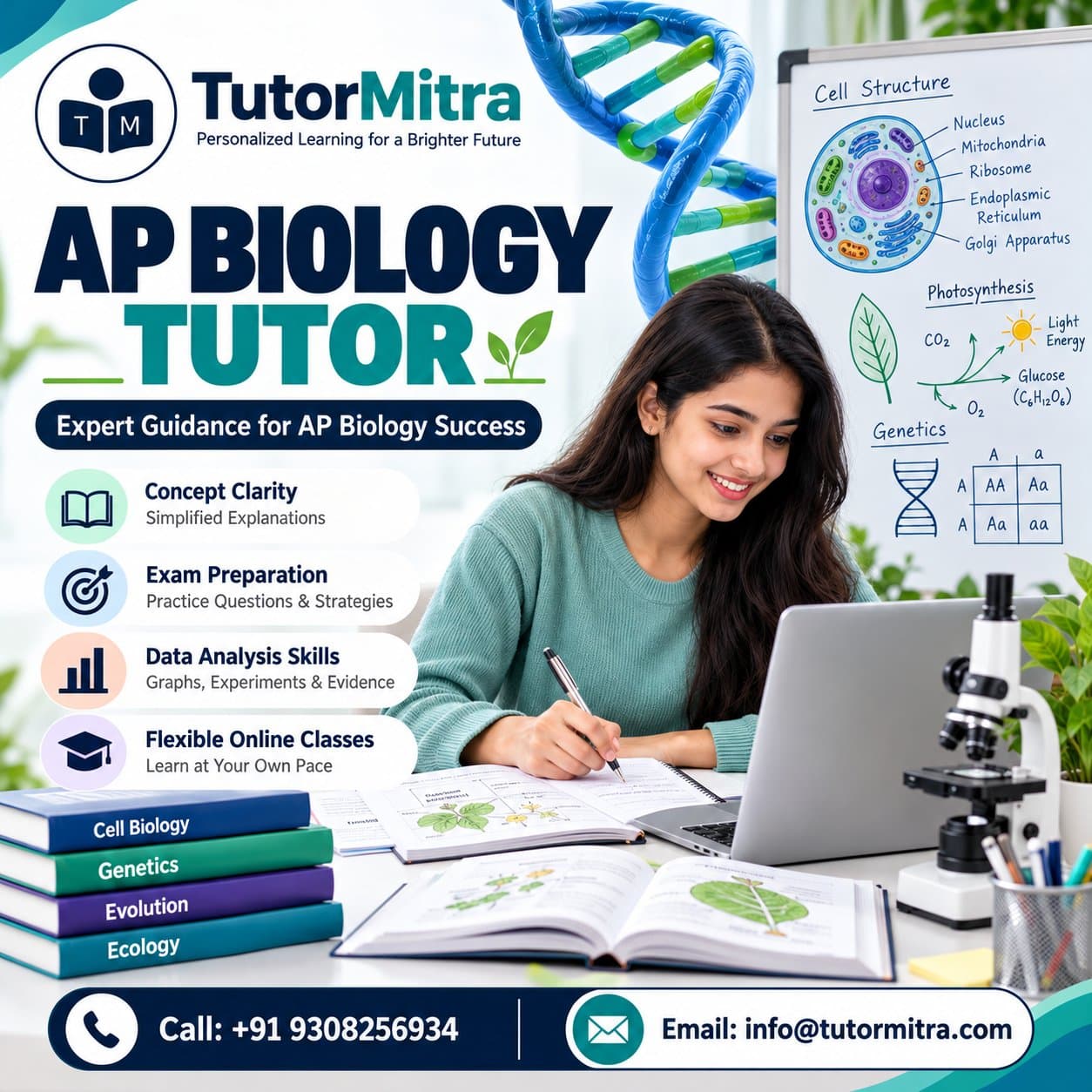
AP Biology Tutor: A Complete Guide to Effective Learning
Introduction Advanced Placement Biology is a challenging course that helps high school students explore living organisms, biological systems, genetics, evolution, and ecology. It requires more than memorizing scientific terms. Students must understand biological processes, interpret experimental data, analyze evidence, and apply concepts to unfamiliar situations. For students balancing demanding coursework, laboratory activities, and examination preparation, these expectations can sometimes feel overwhelming. An AP Biology tutor can provide personalized explanations, structured practice, and guidance to help students strengthen their understanding. Students can also explore top online tutoring sites to compare available academic support, teaching methods, and scheduling options. The right learning approach depends on your current knowledge, academic goals, and the topics you find most difficult. What Does an AP Biology Tutor Do? An AP Biology tutor helps students understand course concepts, practice scientific reasoning, and prepare for assessments. Rather than simply providing definitions, an effective tutor explains how biological processes work and how different ideas connect. For example, a student may understand that enzymes speed up chemical reactions but struggle to explain how temperature affects enzyme activity. A tutor can use diagrams, experimental examples, and practice questions to explain enzyme structure, active sites, and the effects of environmental conditions. An AP Biology tutor may help students with: Understanding difficult biological concepts. Reviewing course topics and identifying knowledge gaps. Interpreting graphs, tables, and experimental results. Practicing scientific explanations using evidence. Developing effective revision strategies. Preparing for multiple-choice and free-response questions. The goal is to develop independent scientific reasoning so students can apply their knowledge confidently. Key Topics Covered in AP Biology AP Biology covers several major areas of biological science. Understanding these topics and their relationships is important for successful learning. 1. Chemistry of Life Students explore water, biological macromolecules, and the chemical foundations of living systems. Understanding carbohydrates, proteins, lipids, and nucleic acids helps explain how organisms function. 2. Cell Structure and Function This topic examines cell organelles, membrane transport, cellular compartmentalization, and how cells maintain their internal conditions. For example, students may compare passive transport with active transport and explain why some substances require energy to cross a cell membrane. 3. Cellular Energetics Students learn about photosynthesis, cellular respiration, enzymes, and energy transfer. These processes explain how organisms obtain and use energy. 4. Cell Communication and Cell Cycle This area covers cellular signaling, feedback mechanisms, cell division, and the regulation of biological processes. 5. Heredity and Gene Expression Students explore meiosis, inheritance, DNA replication, gene expression, and how genetic information influences characteristics. 6. Natural Selection and Ecology These topics examine evolution, population changes, ecosystem interactions, energy flow, and environmental influences on organisms. An AP Biology tutor can divide complex topics into manageable lessons and use diagrams, examples, and practice questions to strengthen understanding. Benefits of Working with an AP Biology Tutor Personalized tutoring can be useful when students need additional explanations or structured preparation. Clearer Understanding of Difficult Concepts A tutor can explain complex processes using simpler language, visual examples, and step-by-step reasoning. Practice with Scientific Reasoning AP Biology requires students to interpret evidence and explain conclusions. Guided practice can help students distinguish observations from interpretations and support claims with relevant evidence. Better Exam Preparation Tutoring sessions can focus on challenging topics, question analysis, and time management. Students can also practice organizing written responses clearly. Personalized Study Plans Students have different strengths and weaknesses. A tutor can help prioritize topics that need additional attention while encouraging independent revision. Feedback on Common Mistakes Reviewing incorrect answers helps students understand why a response is incomplete or scientifically inaccurate. For instance, when analyzing an experiment about plant growth, students may need to identify independent and dependent variables, interpret a graph, and explain whether the results support a hypothesis. Practicing these steps can strengthen scientific reasoning. How to Study AP Biology More Effectively Tutoring is only one part of successful preparation. Consistent independent study is equally important. Use active recall. Close your textbook and explain a biological process from memory. Practice interpreting data. Review graphs, experimental results, and scientific observations. Explain what the evidence supports. Connect related concepts. Link cellular respiration to energy transfer or genetics to inheritance patterns instead of treating every chapter as an isolated topic. Create diagrams. Draw processes such as photosynthesis, meiosis, and cell signaling, then label each stage. Review mistakes. Maintain notes on incorrect answers and revisit the concepts behind them. Practice written explanations. Support conclusions with evidence and explain the biological reasoning behind your answer. For example, when studying natural selection, explain how an inherited trait can influence survival and reproductive success in a particular environment. Then consider how changes in environmental conditions might affect the population over several generations. How to Choose Top Online Tutoring Sites When comparing top online tutoring sites, look beyond promotional claims and consider whether the learning support matches your needs. Check Relevant Subject Expertise Look for tutors who understand AP Biology concepts, experimental analysis, and the demands of the course. Evaluate Teaching Methods Choose an approach that emphasizes conceptual understanding, diagrams, practice questions, and scientific reasoning. Consider Personalized Support One-to-one tutoring may be helpful when you need focused explanations or feedback on specific topics. Review Practice Resources Check whether the service provides suitable exercises, revision materials, and opportunities to discuss mistakes. Compare Scheduling and Costs Consider session availability, fees, cancellation policies, and the time you can realistically commit. Read Reviews Carefully Student reviews may offer useful insights, but avoid relying on unverified claims or promises of guaranteed examination scores. TutorMitra is an option to explore when researching personalized tutoring and academic support. Check the available services and tutor expertise to determine whether they suit your AP Biology learning requirements. Conclusion AP Biology becomes more manageable when students understand biological processes, connect related concepts, and practice applying evidence to scientific questions. An AP Biology tutor can provide personalized explanations, targeted practice, and feedback to support these goals. When comparing top online tutoring sites, consider teaching quality, subject expertise, flexibility, and affordability. TutorMitra is worth exploring as an option for personalized academic support. With regular revision, thoughtful practice, and a clear understanding of scientific concepts, students can strengthen their biology knowledge and approach AP Biology assessments with greater confidence. Visit For More Info : https://www.tutormitra.com/ap_biology-tutors Frequently Asked Questions 1. Why should I consider an AP Biology tutor? A tutor can help clarify difficult concepts, practice scientific reasoning, identify knowledge gaps, and organize exam preparation around your learning needs. 2. Are top online tutoring sites useful for AP Biology? They can be useful when they provide relevant subject expertise, clear explanations, flexible scheduling, and opportunities for feedback. The suitability of a platform depends on the services available and your individual needs. 3. How early should I begin AP Biology exam preparation? Begin by reviewing the course material regularly throughout the school year. Increase focused practice as the examination approaches, giving yourself enough time to address weaker topics. 4. How can I improve my AP Biology free-response answers? Read each question carefully, identify what it asks you to do, and answer directly. Use relevant biological concepts, refer to the supplied data when required, and explain your reasoning clearly. 5. Can I prepare for AP Biology without a tutor? Yes. Textbooks, class notes, practice questions, diagrams, and independent revision can provide effective support. A tutor is an additional option when you need personalized explanations or feedback.
Web Development Tutor Jobs – Teach, Inspire & Grow with TutorMitra Looking for web development tutor jobs? TutorMitra offers opportunities for skilled educators who want to share their knowledge and build a flexible online teaching career. If you have expertise in HTML, CSS, JavaScript, frontend development, backend development, or modern web technologies, you can connect with learners from different backgrounds. With web development teaching jobs, tutors can help students understand coding concepts, create real-world projects, improve problem-solving skills, and develop practical web development abilities. Explore Online Web Development Tutor Jobs with TutorMitra and turn your technical expertise into a meaningful teaching opportunity. #WebDevelopmentTutorJobs #WebDevelopmentTeachingJobs #OnlineWebDevelopmentTutorJobs #WebDevelopmentTutor #OnlineTutorJobs #TutorMitra #WebDevelopment #OnlineTeaching #TeachingJobs #CodingTutor
https://www.tutormitra.com/web_development-tutor-jobs