VVerdoos
Log in
MM

Michael Matthew

@michaelmatthew

2 Posts0 Followers0 Following
MM
Michael Matthew@michaelmatthew· October 21 at 6:49 AM

North America Vision Care Market Size Projected to Reach USD 38.3 Billion by 2034 with a CAGR of 2.58%

IMARC Group has recently released a new research study titled “North America Vision Care Market Report by Product Type, Distribution Channel, and Country, 2026-2034,” that offers a detailed analysis of the market drivers, segmentation, growth opportunities, trends and competitive landscape to understand the current and future market scenarios. North America Vision Care Market Size, Growth, and Forecast (2026-2034) The north america vision care market size reached USD 30.2 Billion in 2025 and is projected to reach USD 38.3 Billion by 2034, growing at a CAGR of 2.58% during 2026-2034. The growing incidence of eye disorders, improvements in vision care services, rising demand for digital eye care solutions, and growing demand for specialty eyewear and contact lenses are the primary factors driving the north america vision care market. Vision care refers to the products and services used to correct, protect, and maintain eyesight. It includes eyeglass lenses, contact lenses, intraocular lenses, contact lens solutions, LASIK equipment, and artificial tears, delivered through retail stores, online platforms, clinics, and hospitals. An aging population is increasing the number of people affected by age-related conditions such as presbyopia, macular degeneration, and diabetic retinopathy, while rising screen time is contributing to myopia and digital eye strain among younger groups. More than 50% of US adults aged 18-44 spend six or more hours a day on digital devices, and almost 70% report symptoms of digital eye strain such as dryness and headaches. Explore Growth Opportunities in the North America Vision Care Market - Grab Your Sample Report for Evaluation: https://www.imarcgroup.com/north-america-vision-care-market/requestsample Key Trends Driving the North America Vision Care Market Growing demand for digital eye care solutions: Telemedicine, remote eye exams, and AI-driven diagnostics are giving patients more convenient ways to monitor and manage their eye health, especially in underserved or rural areas. Topcon’s Maestro2 OCT system, for example, combines fundus photography with OCT imaging of the macula and optic nerve in one device, using automation to reduce patient chair time and improve efficiency. Focus on advanced education: Rising demand for specialized eye care is driving emphasis on advanced training for optometrists and vision care professionals, including PhD programs in vision science. In 2024, EssilorLuxottica donated USD 300,000 to the AAOF OD/PhD Scholarship program to support optometrists pursuing advanced degrees and help address the need for PhD-level faculty. Expansion of specialty eyewear and contact lenses: Consumers are seeking customized solutions for presbyopia, astigmatism, and dry eye, and advances in materials and design are making eyewear more comfortable and functional. In 2024, Johnson & Johnson expanded its TECNIS Odyssey intraocular lens in the US, with 93% of patients reporting no or mild halos, glare, or starbursts after surgery. North America Vision Care Market Report Segmentation: The North America Vision Care Market report provides a detailed segmentation analysis to help businesses identify key growth segments and evolving industry dynamics. The market is categorized based on product type, distribution channel, and country, offering comprehensive insights across the north america vision care market. Product Type Insights: Glass Lenses: Glass lenses dominate the market owing to their durability, optical clarity, and scratch resistance. They are commonly used in prescription glasses for nearsightedness, farsightedness, and astigmatism, and advances in coatings and treatments support their continued prominence. Contact Lenses: Contact lenses are gaining traction as consumers seek specialty options for astigmatism, presbyopia, and dry eye, along with disposable and colored lenses for functional and aesthetic needs. Intraocular Lenses: Intraocular lenses are used in cataract surgery, with demand supported by the aging population and innovation in lens designs that improve visual range and reduce glare. Contact Solutions: Contact solutions support the cleaning, disinfection, and storage of reusable contact lenses, and demand rises with contact lens adoption. Lasik Equipment: LASIK equipment supports laser-based vision correction procedures, with the United States leading in adoption of laser surgeries. Artificial Tears: Artificial tears address dryness and discomfort, with demand driven by prolonged screen time and digital eye strain. Distribution Channel Insights: Retail Stores: Retail stores dominate the market thanks to their accessibility and in-person services. Major chains such as LensCrafters, Sunglass Hut, and Costco let customers try on products, receive eye exams, and get immediate adjustments with trained optometrists. Online Stores: Online stores are expanding as consumers value convenience, price comparison, and home delivery of eyewear and contact lenses. Clinics: Clinics provide eye examinations, diagnosis, and prescriptions, and are a key channel for specialty lenses and personalized care. Hospitals: Hospitals serve surgical vision care needs such as cataract procedures and laser surgeries, as well as treatment of complex eye diseases. Country Insights: United States: The United States dominates the market, supported by advanced healthcare infrastructure, high demand for eye care products, and widespread access to innovative treatments such as LASIK, smart eyewear, and digital eye exams. Strong retail and online distribution channels further support growth. Canada: Canada contributes to regional demand through its established eye care professionals network, aging population, and growing adoption of contact lenses and prescription eyewear. Mexico: Mexico is a growing market as awareness of eye health rises and access to vision correction products and services expands. North America Vision Care Market: Recent News and Developments April 2025: Bruno Vision Care received FDA approval for Deseyne contact lenses featuring FusionTechnology, a hydrogel material embedded with bioactive ingredients that steadily release hydration-enhancing substances to mimic natural tears. The lenses are designed to improve comfort and reduce dryness-related dropout, with a launch planned for late 2025. April 2025: ZEISS Vision Care introduced DuraVision Gold UV AR, a premium anti-reflective lens coating combining a gold hue with advanced performance, including CleanGuard technology for faster cleaning, enhanced scratch resistance, and reduced blue light reflections. It is available across all ZEISS lens types, including prescription sunglasses. Challenges Impacting the North America Vision Care Market The north america vision care market is relatively mature, with projected growth of 2.58%, which makes competition for market share intense and places pressure on pricing, particularly in retail and online channels. New lenses, surgical devices, and diagnostic systems require regulatory approvals and significant investment in research, and a shortage of highly trained professionals and faculty can limit the pace at which advanced care is delivered. Investment Opportunities in the North America Vision Care Market The north america vision care market presents compelling investment opportunities supported by its projected growth from USD 30.2 Billion in 2025 to USD 38.3 Billion by 2034. Specialty contact lenses, premium intraocular lenses, and dry eye solutions represent high-value opportunities as consumers seek personalized, high-performance products. Digital eye care platforms, AI-driven diagnostics, and smart eyewear are a growing investment frontier. Companies that combine product innovation, strong distribution networks, and professional education partnerships can build strong competitive positions in this market. Outlook of the North America Vision Care Market (2026-2034) The outlook for the north america vision care market is stable, supported by an aging population, rising eye disorders, and continuous technological innovation. The market is projected to grow from USD 30.2 Billion in 2025 to USD 38.3 Billion by 2034 at a CAGR of 2.58%. Digital eye care, specialty eyewear and contact lenses, and a growing focus on preventative eye health and personalized care will be the defining trends shaping the north america vision care market through 2034. Key Players in the North America Vision Care Market The north america vision care market is highly competitive, with key players including EssilorLuxottica, Johnson & Johnson Vision, CooperVision, Bausch + Lomb, and Alcon competing through diverse product portfolios, innovation, and strategic collaborations. EssilorLuxottica: A leading eyewear and vision care company, EssilorLuxottica owns brands including Ray-Ban, Oakley, Oliver Peoples, and LensCrafters. In 2024 it exhibited consumer technology innovations at CES in Las Vegas and donated USD 300,000 to the AAOF OD/PhD Scholarship program. Johnson & Johnson Vision: A global leader in eye health, Johnson & Johnson Vision expanded its TECNIS Odyssey intraocular lens in the United States in 2024, offering patients a full range of vision with a high share reporting no or mild halos, glare, or starbursts. Frequently Asked Questions (FAQs): North America Vision Care Market What is the current North America vision care market size? The North America vision care market size reached USD 30.2 Billion in 2025 and is projected to reach USD 38.3 Billion by 2034, growing at a CAGR of 2.58% during 2026-2034. What is vision care? Vision care refers to the products and services used to correct, protect, and maintain eyesight, including eyeglass lenses, contact lenses, intraocular lenses, contact solutions, LASIK equipment, and artificial tears. What are the key drivers of the north america vision care market? Key drivers include an aging population, the increasing prevalence of eye conditions, advancements in technology, growing awareness of eye health, rising demand for personalized and specialty lenses, and the expansion of telemedicine and digital eye care solutions. Which segments lead the North America vision care market? Glass lenses lead by product type, and retail stores lead by distribution channel. The United States is the largest country market. Who are the key players in the north america vision care market? Key players in the north america vision care market include EssilorLuxottica, Johnson & Johnson Vision, CooperVision, Bausch + Lomb, and Alcon. Author IMARC Group IMARC Group is a global management consulting firm that helps the world's most ambitious changemakers to create a lasting impact. The company provide a comprehensive suite of market entry and expansion services. IMARC offerings include thorough market assessment, feasibility studies, company incorporation assistance, factory setup support, regulatory approvals and licensing navigation, branding, marketing and sales strategies, competitive landscape and benchmarking analyses, pricing and cost research, and procurement research. Contact Us IMARC Group, 134 N 4th St. Brooklyn, NY 11249, USA, Email: sales@imarcgroup.com, United States: +1-201971-6302
MM
Michael Matthew@michaelmatthew· October 21 at 4:38 AM

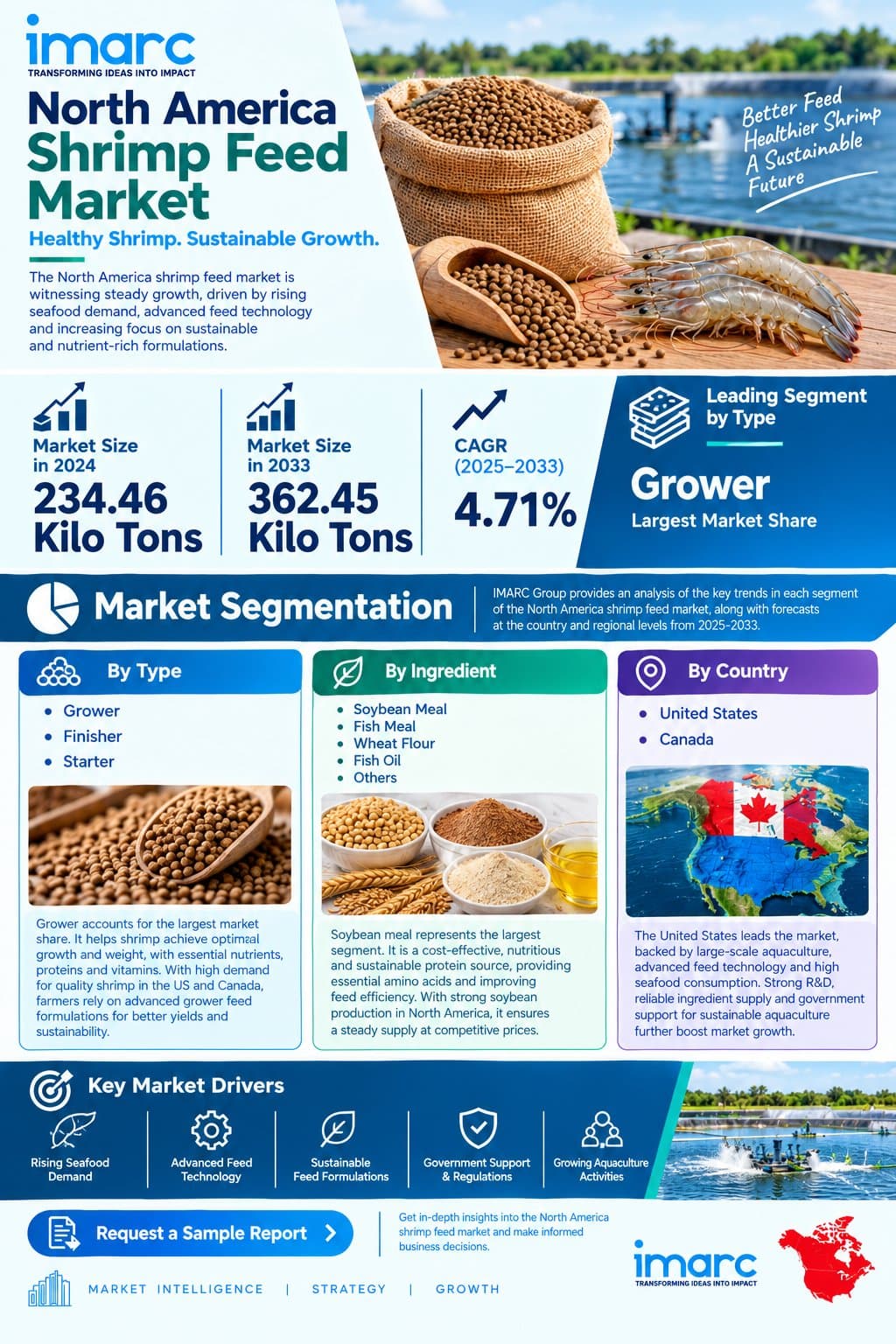
North America Shrimp Feed Market Size Projected to Reach 362.45 Kilo Tons by 2033 with a CAGR of 4.71%

IMARC Group has recently released a new research study titled “North America Shrimp Feed Market Report by Type, Ingredient, and Country, 2025-2033,” that offers a detailed analysis of the market drivers, segmentation, growth opportunities, trends and competitive landscape to understand the current and future market scenarios. North America Shrimp Feed Market Size, Growth, and Forecast (2025-2033) The north america shrimp feed market size reached 234.46 Kilo Tons in 2024 and is projected to reach 362.45 Kilo Tons by 2033, growing at a CAGR of 4.71% during 2025-2033. Increasing focus on sustainable aquaculture, growing shrimp consumption, and rising e-commerce and direct-to-farm sales are the primary factors driving the north america shrimp feed market. Shrimp feed refers to specially formulated nutrition designed to support the growth, health, and survival of farmed shrimp across the starter, grower, and finisher stages. It is typically made from ingredients such as soybean meal, fish meal, wheat flour, and fish oil, along with additives like probiotics, enzymes, and immune-boosting compounds. Controlled-environment shrimp farming is also shaping demand across the region. Indoor and land-based farms use advanced water filtration and monitoring systems, which call for precisely formulated, easily digestible feed that minimizes waste and protects water quality. Year-round production in these settings is raising the need for consistent, high-performance feed. Explore Growth Opportunities in the North America Shrimp Feed Market - Grab Your Sample Report for Evaluation: https://www.imarcgroup.com/north-america-shrimp-feed-market/requestsample Key Trends Driving the North America Shrimp Feed Market • Increasing focus on sustainable aquaculture: Farmers and feed manufacturers are moving away from heavy fishmeal use toward plant-based and alternative proteins such as soybean meal and insect protein, easing pressure on wild fish populations. Feed formulations are also adding probiotics and immune-boosting additives to improve shrimp health and reduce antibiotic use. In December 2024, NOAA Fisheries announced that the council completed its strategic plan for aquaculture economic development, signaling support for infrastructure, research, and capital for the domestic aquaculture industry. • Growing shrimp consumption: Shrimp remains a staple seafood choice, encouraging farmers to expand operations and seek efficient nutrition solutions that improve growth rates and shrimp health. According to IMARC Group, the United States shrimp market reached 983,000 Tons in 2024 and is expected to reach 1,280,000 Tons by 2033, growing at a CAGR of 3% during 2025-2033. In January 2024, the Global Shrimp Council launched its “Global Shrimp – Happy Protein” program, starting in the US, to encourage more frequent shrimp consumption. • Rising e-commerce and direct-to-farm sales: Online platforms and direct-to-farm channels are making feed more accessible, letting farmers compare products, order in bulk, and avoid middlemen, even in remote areas. The US Census Bureau reported that US retail e-commerce sales reached USD 300.1 Billion in the third quarter of 2024, up 2.6% from the second quarter and representing 16.2% of total sales, reflecting the broader shift toward digital purchasing. North America Shrimp Feed Market Report Segmentation: The North America Shrimp Feed Market report provides a detailed segmentation analysis to help businesses identify key growth segments and evolving industry dynamics. The market is categorized based on type, ingredient, and country, offering comprehensive insights across the north america shrimp feed market. Type Insights: • Grower: Grower feed holds the largest share of the market. Since shrimp spend most of their life cycle at this stage, farmers rely on nutrient-rich, protein-dense formulations that support rapid growth, improve survival rates, and enhance feed conversion efficiency. • Finisher: Finisher feed supports final weight gain and harvest readiness, helping farms deliver the size and quality demanded by restaurants and seafood suppliers. • Starter: Starter feed supports the early life stages of shrimp, providing the foundation for healthy development and strong performance in later stages of the farming cycle. Ingredient Insights: Soybean Meal: Soybean meal represents the largest ingredient segment. It is a cost-effective, sustainable protein source that supplies essential amino acids, improves feed efficiency, and serves as a practical alternative to fishmeal, backed by a strong regional soybean production base. Fish Meal: Fish meal remains a traditional protein source in shrimp diets, though its cost and environmental impact are encouraging formulators to blend in more plant-based and alternative proteins. Wheat Flour: Wheat flour is used as a carbohydrate source and binding agent in shrimp feed formulations, supporting pellet quality and balanced nutrition. Fish Oil: Fish oil contributes essential fatty acids that support shrimp growth and health within balanced feed formulations. Others: Other ingredients, including insect meal and algae-based inputs, are gaining popularity as sustainable options in shrimp feed. Country Insights: United States: The United States holds the leading position in the market, supported by large-scale aquaculture activity, advanced feed technology, high shrimp consumption, and a steady supply of ingredients such as soybean meal. A strong base of feed manufacturers investing in research and development is also advancing nutrient-rich, sustainable formulations. Canada: Canada contributes to regional demand as shrimp consumption and interest in high-quality seafood continue to grow, supporting the need for reliable, high-performance feed. North America Shrimp Feed Market: Recent News and Developments July 2024: String Bio, a biotechnology firm, obtained Generally Recognized as Safe (GRAS) status in the US for its novel microbial protein, PRO-DG, intended for crustacean feed. The protein was developed to deliver an optimal amino acid profile, with improved digestibility and performance confirmed in multiple aquaculture trials. December 2024: The US Grains Council hosted aquaculture nutritionists from Ecuador and Panama to promote sustainable use of distiller’s grains with solubles (DDGS) and corn-fermented proteins in aquaculture diets, highlighting export opportunities tied to shrimp feed. Challenges Impacting the North America Shrimp Feed Market Traditional shrimp feed has depended on fishmeal, which is costly and puts pressure on marine resources. Reformulating diets around plant-based and alternative proteins requires ongoing research to maintain nutrient quality, digestibility, and shrimp performance. Newer ingredients such as insect protein and microbial protein are still scaling toward industrial production in the region, which can limit availability and keep costs higher for farms seeking sustainable, high-performance feed. Investment Opportunities in the North America Shrimp Feed Market The north america shrimp feed market presents compelling investment opportunities supported by its projected growth from 234.46 Kilo Tons in 2024 to 362.45 Kilo Tons by 2033. Sustainable and alternative protein ingredients represent a high-value opportunity as farms and regulators place greater emphasis on responsible aquaculture. Tailored feed solutions for indoor and land-based shrimp farms, along with digital and direct-to-farm sales platforms, are a growing investment frontier. Companies that combine innovative formulations with technical support and strong distribution networks can build strong competitive positions in this expanding market. Outlook of the North America Shrimp Feed Market (2025-2033) The outlook for the north america shrimp feed market is positive, supported by rising shrimp consumption, the shift toward sustainable aquaculture, and continuous innovation in feed formulation. The market is projected to grow from 234.46 Kilo Tons in 2024 to 362.45 Kilo Tons by 2033 at a CAGR of 4.71%. Continued adoption of plant-based and alternative proteins, precision feeding technologies, and controlled-environment farming will be the defining trends shaping the north america shrimp feed market through 2033. Key Players in the North America Shrimp Feed Market The north america shrimp feed market is served by a mix of established feed manufacturers and innovative ingredient companies competing on the basis of formulation quality, sustainability, and technical support for farmers. Zeigler Bros., Inc.: A Pennsylvania-based aquaculture feed company, Zeigler develops and manufactures premium feeds for all stages of fish and shrimp, with an emphasis on research and development, and offers feed mill technology transfer to partners. Innovafeed: A biotechnology company producing insect-based ingredients, Innovafeed inaugurated its Innovation and Research Center in Decatur, Illinois in January 2024, marking its first step toward industrial production in North America and planning to supply insect protein to aquaculture businesses. Frequently Asked Questions (FAQs): North America Shrimp Feed Market 1. What is the current North America shrimp feed market size? The North America shrimp feed market size reached 234.46 Kilo Tons in 2024 and is projected to reach 362.45 Kilo Tons by 2033, growing at a CAGR of 4.71% during 2025-2033. 2. What is shrimp feed? Shrimp feed refers to specially formulated nutrition made from ingredients such as soybean meal, fish meal, wheat flour, and fish oil, designed to support the growth, health, and survival of farmed shrimp across their life stages. 3. What are the key drivers of the north america shrimp feed market? Key drivers include the increasing focus on sustainable aquaculture, growing shrimp consumption, technological advancements in feed formulations, and rising e-commerce and direct-to-farm sales that improve feed accessibility. 4. Which type and ingredient segments lead the North America shrimp feed market? Grower feed accounts for the largest share by type, owing to its essential role in shrimp growth and strong demand from commercial farms. Soybean meal leads by ingredient, owing to its high protein content, cost-effectiveness, and role as a plant-based alternative to fishmeal. 5. Who are the key players in the north america shrimp feed market? Key players in the north america shrimp feed market include Zeigler Bros., Inc. and Innovafeed, alongside other feed manufacturers and ingredient innovators serving shrimp farms across the United States and Canada. Author IMARC Group IMARC Group is a global management consulting firm that helps the world's most ambitious changemakers to create a lasting impact. The company provide a comprehensive suite of market entry and expansion services. IMARC offerings include thorough market assessment, feasibility studies, company incorporation assistance, factory setup support, regulatory approvals and licensing navigation, branding, marketing and sales strategies, competitive landscape and benchmarking analyses, pricing and cost research, and procurement research. Contact Us IMARC Group, 134 N 4th St. Brooklyn, NY 11249, USA, Email: sales@imarcgroup.com, United States: +1-201971-6302

Photo shared by Michael Matthew: IMARC Group has recently released a new research study titled “North America Shrimp Feed Market Repo