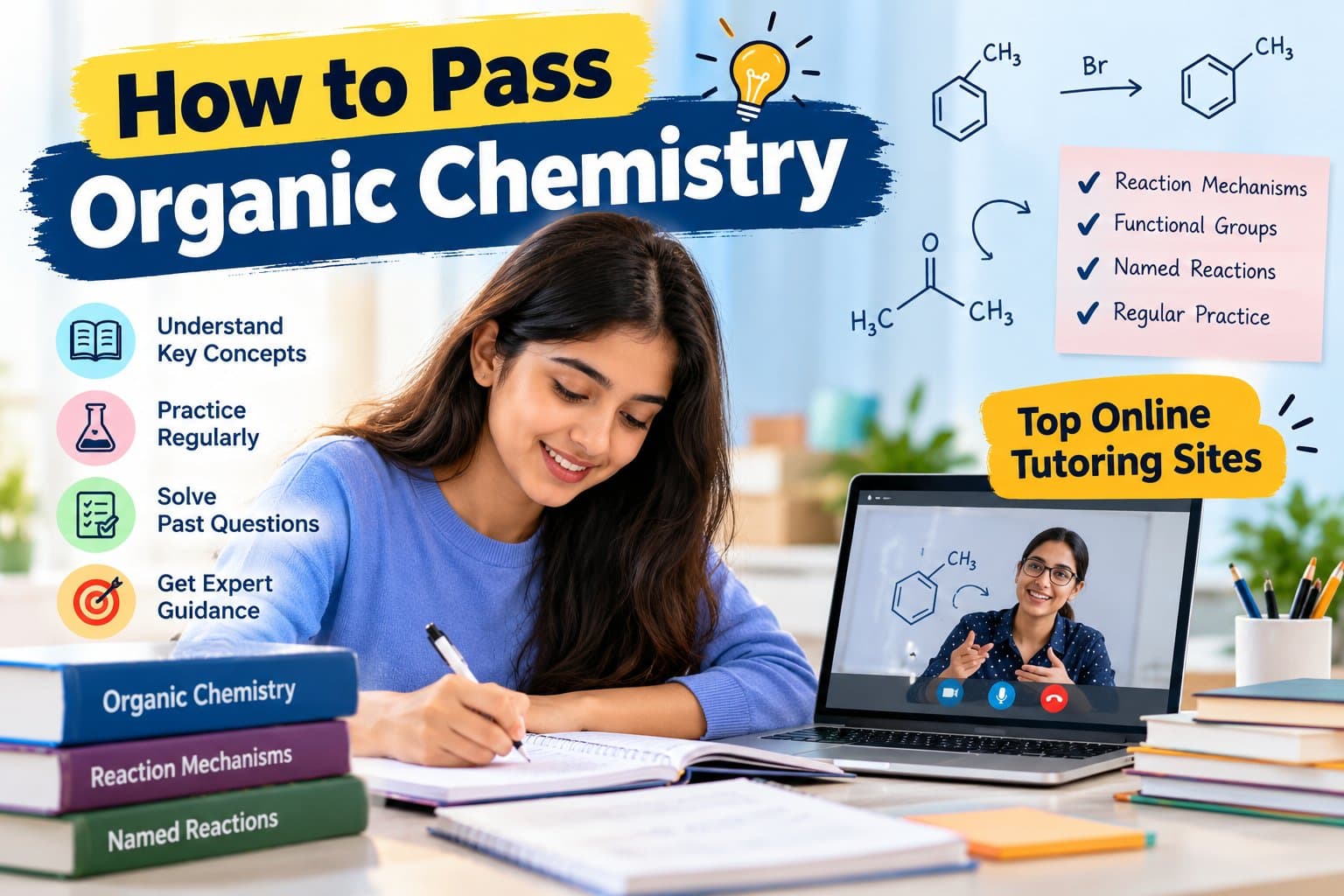
How to Pass Organic Chemistry: A Complete Student Study Guide Organic chemistry is often considered one of the most challenging subjects in science because it requires students to understand molecular structures, reaction mechanisms, chemical properties, and complex problem-solving techniques. Many students struggle when they try to memorize hundreds of reactions without understanding why they occur. The good news is that organic chemistry becomes more manageable when you follow a structured study plan. Learning fundamental concepts, practising reactions regularly, and reviewing mistakes can help you develop a stronger understanding of the subject. If you are wondering how to pass organic chemistry, this guide provides practical study techniques, revision strategies, and advice on finding academic support. Whether you are preparing for school examinations, college assessments, or competitive entrance tests, these methods can help you study more effectively. 1. Build a Strong Foundation in Organic Chemistry Before studying advanced reactions, make sure you understand the basic principles. Organic chemistry topics are interconnected, so gaps in fundamental knowledge can make later chapters difficult. Understand Chemical Bonding and Molecular Structure Start by reviewing covalent bonding, hybridization, molecular geometry, electronegativity, and bond polarity. These concepts explain how atoms interact and why particular bonds behave differently. For example, understanding the difference between a single bond and a double bond helps you recognize why alkenes commonly undergo addition reactions. Learn Functional Groups Functional groups determine many of the chemical properties and reactions of organic compounds. Study the structures and characteristic reactions of alcohols, aldehydes, ketones, carboxylic acids, amines, and other groups included in your syllabus. Create short notes containing each functional group's structure, important properties, and common reactions. Understand Acidity and Basicity Learn how molecular structure affects acidity and basicity. Consider factors such as resonance, electronegativity, and the stability of conjugate bases. These concepts are useful when predicting reaction outcomes and understanding reaction mechanisms. 2. Understand Reaction Mechanisms Instead of Memorizing Everything One of the most effective strategies for learning organic chemistry is understanding why reactions occur rather than memorizing isolated equations. Reaction mechanisms explain how electrons move, which bonds break, and which new bonds form. Learn Electron Movement Practise drawing curved arrows to show the movement of electron pairs. Pay attention to nucleophiles, electrophiles, leaving groups, and reaction intermediates. Work through each mechanism slowly until you understand every step. Group Similar Reactions Together Organize reactions into categories such as substitution, addition, elimination, and oxidation-reduction. Recognizing patterns can help you approach unfamiliar questions more logically. Practise Predicting Products After studying a reaction, cover the answer and predict the product yourself. Then check your reasoning against your textbook or class notes. This method helps you test your understanding instead of simply recognizing a familiar answer. 3. Create a Realistic Organic Chemistry Study Plan A consistent routine can make a large syllabus easier to manage. Divide your preparation into smaller goals rather than attempting to study several difficult chapters at once. A useful daily routine might include: 15 minutes: Revise previously studied concepts. 25 minutes: Learn a new topic or reaction mechanism. 25 minutes: Solve practice questions independently. 15 minutes: Review incorrect answers and update your notes. Adjust these times according to your schedule and the difficulty of the material. At the end of each week, review the topics you studied and complete a short practice test. Use the results to identify areas that require additional attention. 4. Use Active Recall and Spaced Revision Reading the same chapter repeatedly can create a feeling of familiarity without confirming that you can recall the information independently. Active recall involves retrieving information from memory without looking at your notes. For example, write down the reactions of alcohols that you remember, including the reagents and conditions. Then compare your answers with your notes and correct any omissions. Spaced revision involves revisiting material at increasing intervals. You might review a topic the next day, several days later, and again the following week. Combining active recall with spaced revision can help reinforce important concepts and reveal weaknesses before an examination. 5. Practise Organic Chemistry Questions Every Day Practice is essential because organic chemistry examinations often require students to apply concepts to unfamiliar structures and reaction sequences. Start with basic questions and gradually progress to more challenging problems. Practise identifying functional groups, naming compounds, predicting products, completing mechanisms, and explaining reaction conditions. Practical Example: Dehydration of Ethanol Under suitable acidic conditions and heat, ethanol can undergo dehydration to form ethene. CH3CH2OHCH2=CH2+H2O Instead of memorizing this equation alone, ask yourself: What is the starting compound? Which reaction conditions are required? What happens to the hydroxyl group and a hydrogen atom? How does the carbon-carbon double bond form? Answering these questions helps you connect the equation with the underlying chemistry. Maintain a notebook of incorrect answers and record the reason for each mistake. Reviewing these errors can be more useful than repeatedly solving questions you already understand. 6. Prepare Strategically for Organic Chemistry Exams As your examination approaches, prioritize revision and practice rather than attempting to learn every topic from scratch. Begin by reviewing your syllabus and identifying the topics that carry the most emphasis in your course. Revisit foundational concepts before tackling complex reaction sequences. Complete practice papers or examination-style questions when available. Use timed exercises to improve your pacing, but always review the reasoning behind incorrect answers. Avoid sacrificing sleep to study throughout the night. Adequate rest and a manageable revision schedule can support concentration and memory. If you repeatedly struggle with a particular concept, ask your teacher or tutor for clarification rather than allowing the confusion to continue. 7. When Should You Consider Additional Academic Support? Some students can study organic chemistry independently, while others benefit from personalized explanations and guided practice. An organic chemistry tutor may help you understand reaction mechanisms, identify knowledge gaps, and develop a study plan suited to your learning needs. When comparing Good Tutoring websites, look for subject expertise, clear teaching methods, personalized instruction, flexible scheduling, transparent pricing, and credible student feedback. Choose a tutor who encourages you to solve problems independently rather than simply giving you answers. TutorMitra is one platform students can explore when considering personalized academic support. Check the available tutoring options to determine whether they match your subject requirements and learning goals. Conclusion Learning how to pass organic chemistry becomes easier when you focus on understanding concepts, practising reaction mechanisms, and reviewing mistakes consistently. Build a strong foundation, use active recall, follow a realistic study schedule, and practise questions that test your ability to apply what you have learned. If you need additional guidance, consider a qualified tutor and compare Good Tutoring websites carefully before choosing a learning platform. TutorMitra is one option to explore for personalized academic support. With consistent effort, a clear study plan, and the right learning resources, you can strengthen your organic chemistry knowledge and approach your examinations with greater confidence. Frequently Asked Questions 1. How many hours should I study organic chemistry daily? The ideal amount depends on your current understanding, syllabus, and examination date. Consistent, focused study sessions with regular practice are generally more useful than irregular last-minute preparation. 2. Is organic chemistry mostly memorization? Memorization has a role, but understanding molecular structure, reaction mechanisms, and chemical principles is essential for applying knowledge to unfamiliar questions. 3. How can I remember organic chemistry reactions? Group similar reactions, understand their mechanisms, create reaction summaries, and test your memory through active recall and spaced revision. 4. What should I do if I cannot understand reaction mechanisms? Return to fundamental concepts such as electron movement, nucleophiles, electrophiles, and bond polarity. Work through simple examples before attempting more complex mechanisms, and seek clarification when needed. 5. Can a tutor help me pass organic chemistry? A tutor can explain difficult concepts, provide structured practice, and identify learning gaps. However, passing an examination depends on your preparation, understanding, practice, and performance on the day.